Policy and Basic Approach
Our Company established the “Human Rights Policy for the Group of Sumitomo Bakelite Co., Ltd.” on February 1, 2024 to serve as a guideline for our Group’s efforts to respect human rights in our Group’s business activities. This policy has been established in accordance with international standards on human rights such as the United Nations’ “Guiding Principles on Business and Human Rights” and the Japanese Government’s “Guidelines on Respecting Human Rights in Responsible Supply Chains”, and was approved by our Company’s Board of Directors after passing through our Company’s Sustainability Promotion Committee.
Human Rights Policy for the Group of Sumitomo Bakelite Co., Ltd. (Established on February 1, 2024)
1. Purpose
Sumitomo Bakelite Co., Ltd. has established this “Human Rights Policy for the Group of Sumitomo Bakelite Co., Ltd.” (hereinafter “Policy”), to guide Sumitomo Bakelite Co., Ltd. and its subsidiaries (hereinafter “Our Group”) efforts to respect human rights in Our Group’s business activities, together with the “Business Philosophy,” “Our Code of Conduct,” “Code of Ethics for Group of Sumitomo Bakelite Co., Ltd.” etc.
2. Basic Principles on Human Rights/Supporting and Respecting International Standards on Human Rights
Our Group will support and respect the internationally recognized human rights which are defined in the “International Bill of Human Rights (“Universal Declaration of Human Rights,” “International Covenant on Civil and Political Rights,” and “International Covenant on Economic, Social and Cultural Rights”),” ILO’s “Declaration on Fundamental Principles and Rights at Work,” etc. Our Group will support and respect the UN “Guiding Principles on Business and Human Rights,” the “OECD Guidelines for Multinational Enterprises” and other international standards on human rights, and will conduct our Group’s business activities in accordance with these international standards on human rights.
Our Group will comply with the laws and regulations of each country/region where Our Group conducts its business activities. If there are any conflicts between the laws and regulations of each country/region and these international standards on human rights, we will seek ways to respect these international standards on human rights as much as possible.
3. Basic Principles on Human Rights / Respect for Human Rights through Business Activities
Our Group will fulfill its responsibility to respect human rights, by not violating the human rights of those who are affected by Our Group’s business activities, and by taking appropriate measures for corrective action if it becomes clear that Our Group’s business activities have caused or contributed to adverse impacts on the human rights.
Our Group recognizes that its commitment to human rights issues related to the Group’s business activities , including the following, is an important element in fulfilling its responsibility to respect human rights.
(1) Prohibition of child labor
Our Group will not tolerate any child labor (especially “the worst forms of child labor,” such as forced or compulsory recruitment into armed conflict and work by its nature that is likely to harm the health, safety, or morals of children).
(2) Prohibition of forced labor
Our Group will not tolerate modern slavery in the forms of forced labor, debt bondage (work in situations where a person is forced to work for an employer to repay a debt) and human trafficking.
(3) Prohibition of discrimination
Our Group will not tolerate discrimination in any way based on sex, age, nationality, ethnicity, race, religion, ideology or creed, sexual orientation or gender identity, or disability, etc. in employment and work situations.
(4) Prohibition of harassment and violence
Our Group will not tolerate harassment or behavior that harms others, whether mentally or physically.
(5) Respect for fundamental labor rights
In addition to complying with laws and regulations related to fundamental labor rights (freedom of association, workers’ right to collective bargaining, etc.), Our Group will support and respect these rights.
(6) Reduction of excessive working hours
In addition to complying with laws and regulations and managing working hours, overtime, holidays, and vacations appropriately, Our Group will endeavor to reduce excessive working hours.
(7) Payment of appropriate wages and allowances
Our Group will pay wages and appropriate allowances that exceed the legally mandated minimum wage and meet the living wage (the wage necessary for basic, but decent life style).
(8)Ensuring a safe and healthy working environment
Our Group will actively endeavor to ensure a safe and healthy working environment based on Our Group’s Safety Philosophy, “Safety is the first priority of all.”
4. Scope of Application
This Policy applies to all directors, officers, and employees of Our Group. In addition, Our Group expects all business partners who are involved in Our Group’s business activities, products, and services, to understand and support this Policy.
5. Human Rights Due Diligence
Our Group will establish an appropriate human rights due diligence system and mechanism in accordance with the United Nations “Guiding Principles on Business and Human Rights,” and Our Group will identify the adverse impacts on human rights of those who are affected by Our Group’s business activities, and will endeavor to prevent and reduce such adverse impacts.
6. Training
In order to ensure that this Policy is incorporated into all Our Group’s business activities and implemented effectively, Our Group will provide appropriate training to our directors, officers, and employees, and will endeavor to ensure that all business partners and other persons who are affected by Our Group’s business activities understand this Policy.
7. Dialogue and Consultation with Stakeholders
In Our Group’s efforts to respect human rights, Our Group will engage in dialogue and consultation with stakeholders, including human rights experts, labor unions, business partners etc., and will promote comprehensive measures based on specialized knowledge and a wide range of ideas.
8. Grievance Mechanism
Our Group will maintain the existing whistleblowing and consultation contacts to ensure access to remedies from within and outside Our Group, and will work to develop and operate a more effective grievance mechanism.
9. Information Disclosure
Our Group will regularly disclose information on the progress and results of our efforts to respect human rights based on this Policy through Our Group’s website and other means.
This Policy was resolved by the board of directors meeting of Sumitomo Bakelite Co., Ltd. held on January 31, 2024.
End

Systems (Governance)
Human Rights Due Diligence (DD) Promotion System
From FY2024, we embarked on human rights DD in accordance with international standards on human rights such as the United Nations’ “Guiding Principles on Business and Human Rights” and the Japanese Government’s “Guidelines on Respecting Human Rights in Responsible Supply Chains”.
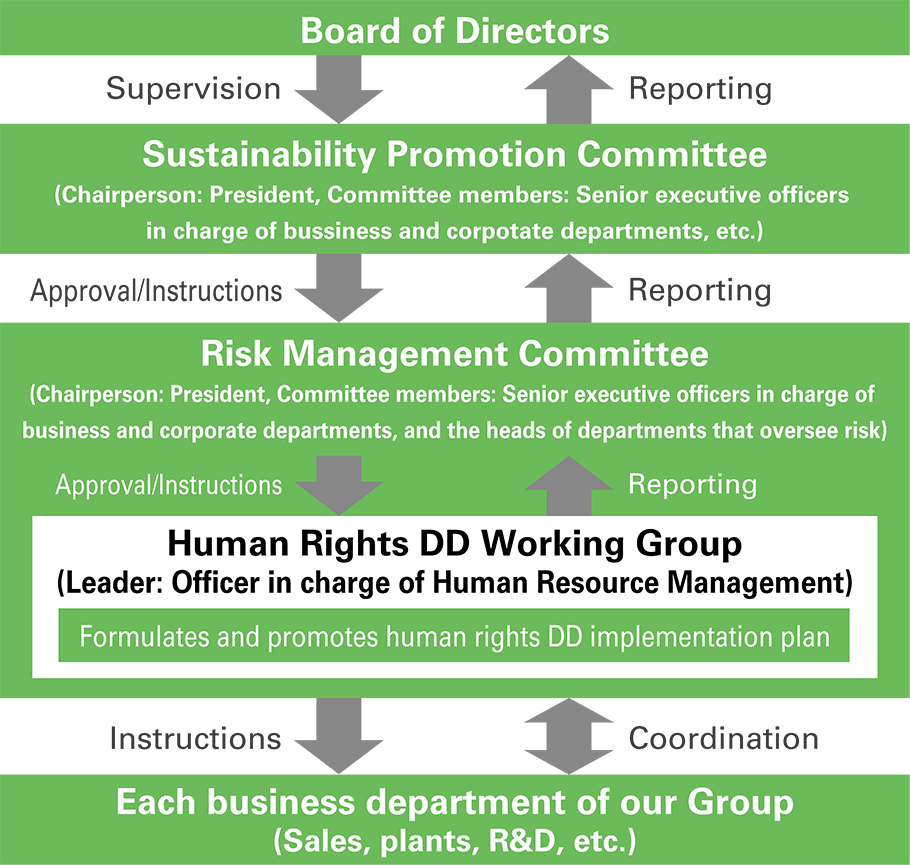
We have established a cross-organizational “Human Rights DD Working Group” (leader: Officer in charge of Human Resource Management) within the Risk Management Committee (chairperson: President, members: Senior Executive Officers in charge of business and corporate divisions , and the heads of departments that oversee risk), to develop and promote a human rights DD implementation plan under the supervision of the Risk Management Committee.
Grievance Mechanism
As a means of relief in cases where our Group is causing or contributing to negative impacts on human rights, our Group have established a reporting and consultation contacts (Compliance Reporting System) that can be used by all stakeholders of our Group, which includes our Group’s Director, Officer, and employees, as well as retired employees, job applicants, and business partners. The Compliance Reporting System allows for anonymous reporting. Any information that could lead to the identification of the whistleblower must be kept confidential, and searching for the identity of the whistleblower or any detrimental treatment of whistleblowers are prohibited. Additionally, dedicated “Harassment Contact Points” have been set up at Sumitomo Bakelite Co., Ltd. and subsidiaries in Japan as part of a system that allows employees to discuss their concerns related to various forms of harassment, including power harassment, sexual harassment, and maternity harassment. Some subsidiaries overseas have also developed their own internal whistleblower systems and grievance mechanisms. Our Group will continue to develop grievance mechanisms that are increasingly more effective.
Risk Management
Implementation of Human Rights Due Diligence (DD)
We plan to implement steps (1) to (4) of our Group's human rights DD process shown in this diagram as a three-yearly cycle. Progress and details will be shown on this page of our website (Sustainability > Society > Respect for Human Rights) as and when appropriate.
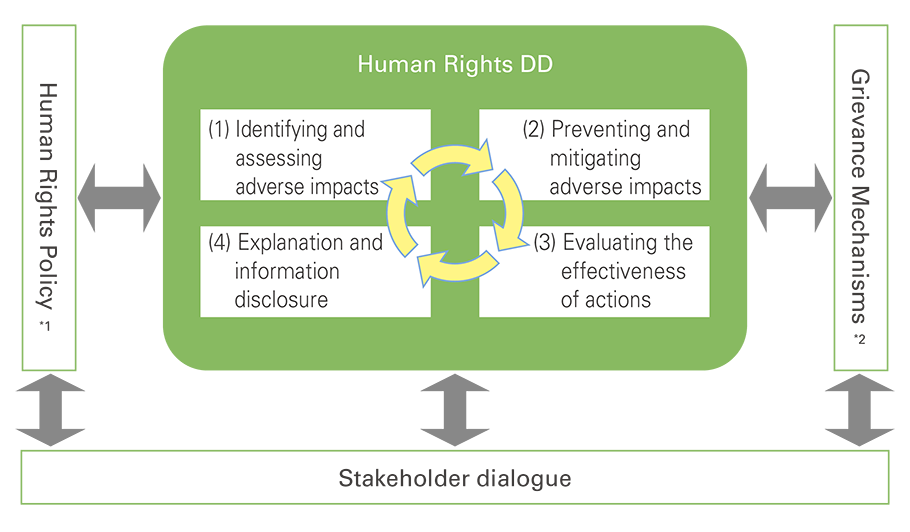
- *1 Established in February 2024
- *2 Whistleblowing system, harassment consultation system, etc.
Results of human rights DD initiatives in FY2024
In FY2024, we implemented step (1) above: “Identifying and assessing adverse impacts on human rights (human rights violation risks).”
- Desktop research to identify human rights issues to be addressed as a priority
- Investigate expert information*1 from international organizations and civil society organizations, as well as actual cases where risks have materialized, to identify adverse impacts on human rights that could occur in our Group’s business and our value chain, taking into consideration risks by industry, risks by product/service, and geographical risks
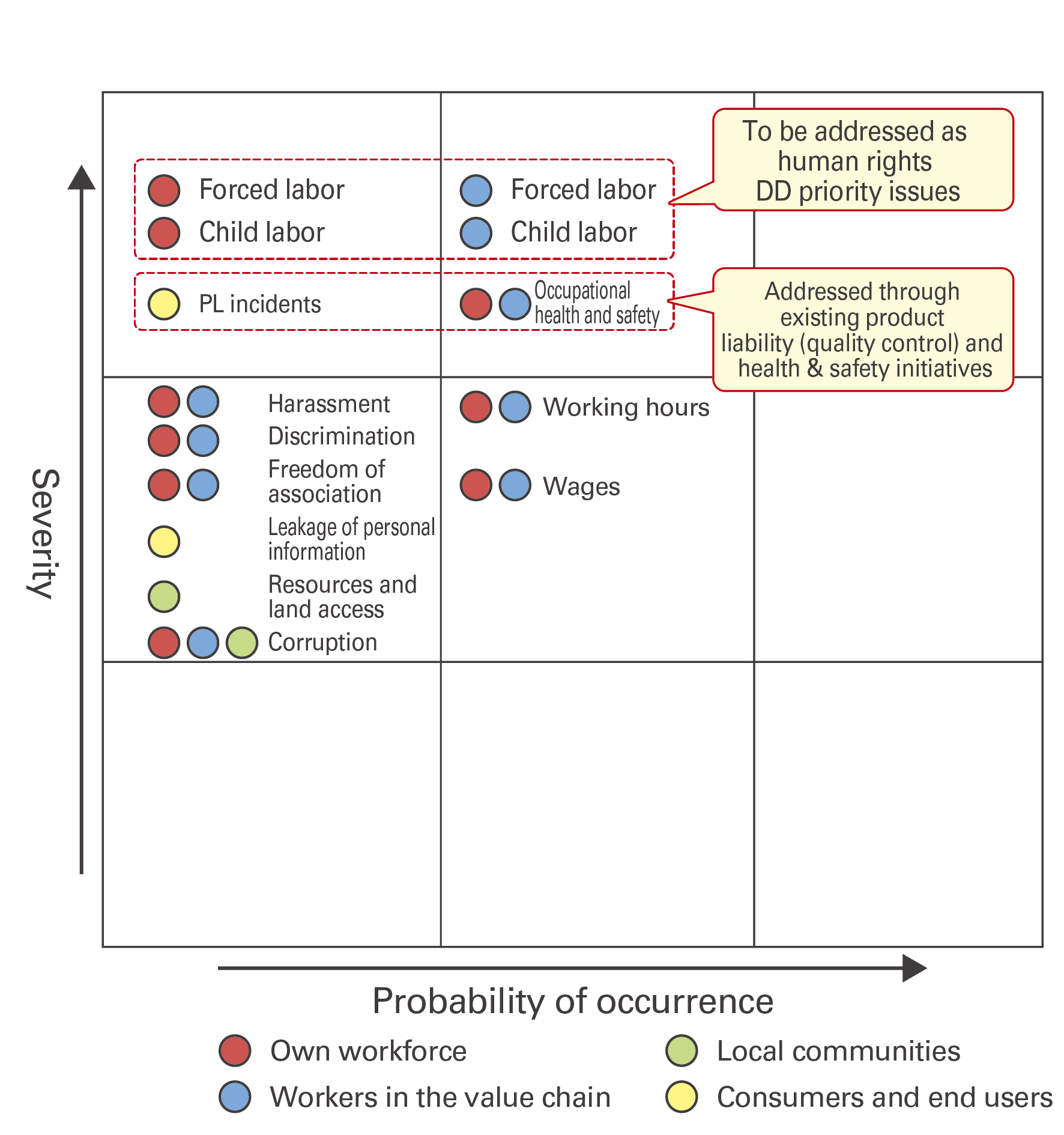
- Risk mapping by estimating the severity (scale, scope, difficulty of recovery) and probability of occurrence of each risk identified
- Child labor and forced labor selected as human rights issues to be addressed as a priority*2
- Identify high-risk suppliers from among our raw materials suppliers, based on the “List of Goods Produced by Child Labor or Forced Labor” published by the U.S. Department of Labor
- *1 Caux Round Table Japan “Human Rights Issues by Sector ”; U.S. Department of Labor “List of Goods Produced by Child Labor or Forced Labor,” etc.
- *2 Starting from issues with higher level of risk (severity × probability of occurrence). For issues with the same level of risk, action to be taken in order of “severity” > “probability of occurrence”
Planned human rights DD initiatives in FY 2025 onwards
As step (2) in the human rights DD process described above, in FY 2025–2026we plan to conduct written surveys (for our Group's sites and suppliers) regarding child labor and forced labor, and then respond to the survey results (by taking corrective actions, etc.)
Targets of child labor and forced labor surveys to be conducted in FY2025 and FY2026
| FY2025 | FY2026 |
|
|
Metrics and Targets
We have selected respect for human rights as one of our Group’s “material issues”, and set progress on human rights DD as a KPI. Other KPIs which we set and manage relating to our “material issues” regarding respect for human rights are the sustainable procurement rate and usage rate of smelters conforming to RMAP concerning 3TG.
Key Initiatives
Internal training on human rights
We provide e-learning training on human rights for all employees of our Company and affiliated companies in Japan, as well as some employees of overseas affiliated companies, to coincide with “Human Rights” Week in every December.
There were two main themes of training in FY2024: “Business and Human Rights” and “Harassment Prevention Training.”
“Business and Human Rights” is training focusing on global trends surrounding business and human rights, the need for companies to address human rights, and the status of our Company’s efforts.
“Harassment Prevention Training” encourages our employees to correctly understand various types of harassment, including “power harassment”, “sexual harassment”, and “harassment related to pregnancy, childbirth, and childcare leave”, and to take steps to prevent such harassment. We also mentioned what actions should be taken in the event of harassment, and disseminated the process for resolution and relief.
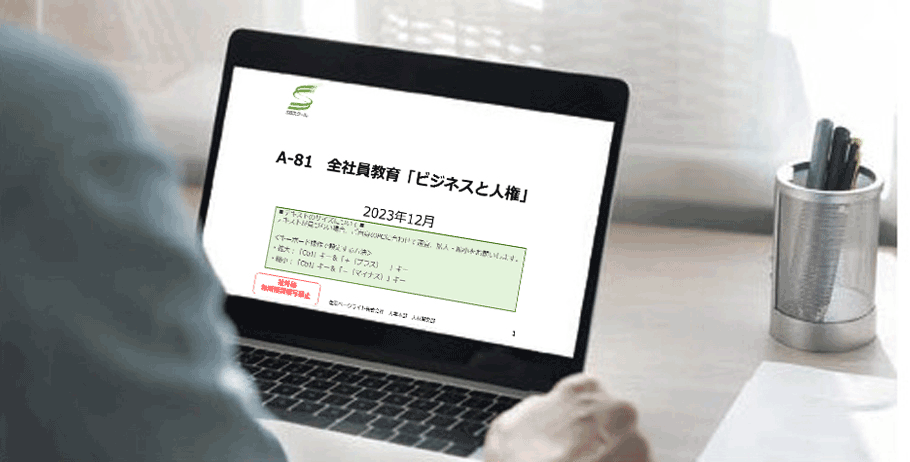
- Employees receive computer-based internal training
Measures to ensure respect for human rights throughout the supply chain
We have established our Sustainable Procurement Policy and take human rights into consideration in our procurement activities.
We conduct sustainable procurement questionnaire survey of major suppliers, which includes requirements for human rights, labor, health and safety, etc., to confirm the status of human rights initiatives in the supply chain.
As part of our ongoing efforts regarding responsible mineral sourcing, we established the “Responsible Mineral Sourcing Policy for the Group of Sumitomo Bakelite Co., Ltd.” and conduct surveys of the suppliers that handle raw materials and parts in which tin, tantalum, tungsten, gold, cobalt, and/or mica is used or added, by using the Conflict Minerals Reporting Template (CMRT)/Extended Minerals Reporting Template (EMRT) published by RMI.
Please see the link below for the details on our Procurement Policy, sustainable procurement questionnaire survey, and responsible mineral sourcing.
Initiatives related to occupational health and safety
Please see the link below for our Group’s initiatives related to occupational health and safety.
Initiatives related to product liability and quality assurance
Please see the link below for our Group’s initiatives related to product liability and quality assurance.
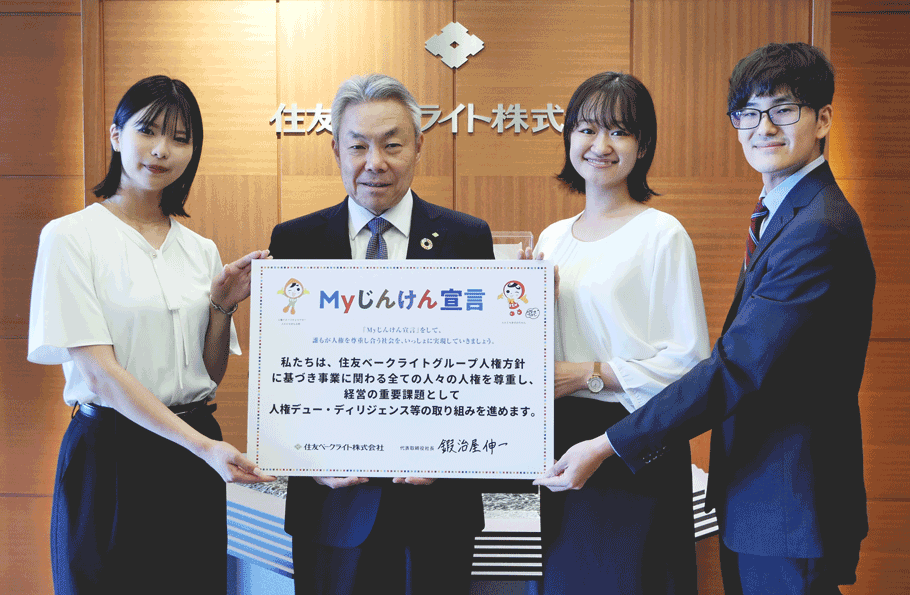
Endorsed the “My Declaration of Human Rights”
The Group has announced its endorsement of the aims of the “My Declaration of Human Rights” project by the “Ministry of Justice” and the National Federation of Consultative Assemblies of Civil Liberties Commissioners. The “My Declaration of Human Rights” is an initiative to realize a society in which everyone respects human rights and companies, organizations, and individuals declare that they will take actions to respect human rights.