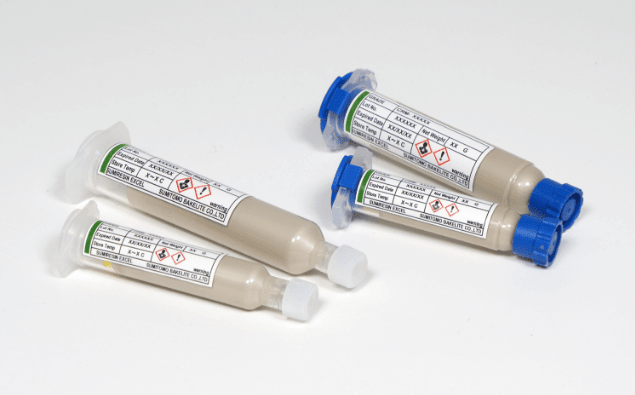
Adhesive for Die BondingSUMIRESIN EXCEL™ CRM
With production facilities in Japan, China and Singapore, we deliver high-standard,
high-quality products with on-time delivery to customers worldwide.
Sumitomo Bakelite is actively
developing materials for advanced packaging and conventional packaging applications.
Features
Offering good reliability and excellent heat dissipation properties
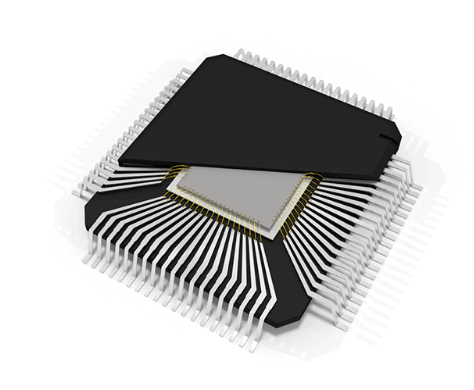
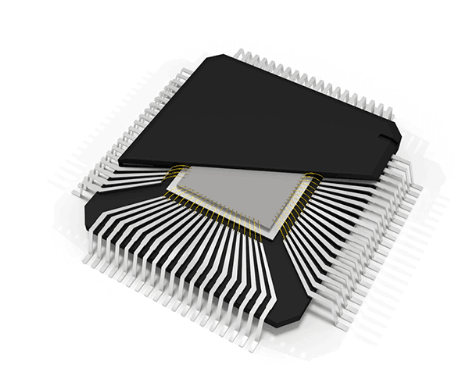
The CRM series is a one-component die-bonding material for semiconductors, suitable for
applications ranging from general-purpose packages to thin and large packages. It contributes to enhancing
the reliability of advanced packages
In addition to die bonding, it is also widely used for bonding
various electronic device components
We also offer high thermal conductivity die- bonding materials
utilizing sintering technology, which are used in LEDs and other applications.
Summary
Role of CRM
- Bonding of various components
- Internal stress relaxation
- External heat dissipation
- Electrical conductivity/insulation
etc.
Application
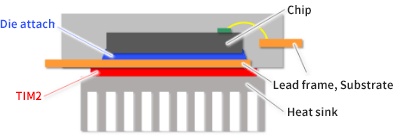
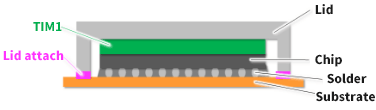
Bonding of IC chips and various parts (TIM1, TIM2, lid attach applications, etc.)
Specifications
Product lineup
| Grade | Features | Main applications |
|---|---|---|
| CRM-1030 series | Oven curing type | SOT、DIP、SO、PLCC、QFP |
| CRM-1060 series | Snap curing time | SOT、DIP、SO、PLCC、QFP |
| CRM-1070 series | Low stress type | DIP、SO、PLCC、QFP、L/TQFP、TSOP、LF CSP |
| CRM-1080 series | High adhesion and High electrical conductivity type | Small chip (SOT, LED, etc.) |
| CRM-1100 series | Insulation type | SOT、DIP、SO、PLCC、QFP、L/TQFP、TSOP、LF CSP |
| CRM-1200 series | Medium thermal conductivity type | DIP、SO、PLCC、QFP、L/TQFP、TSOP |
| CRM-1500 series | Laminated substrate type | PBGA、FPBGA、FCBGA |
| CRM-1700 series | Radical curing type, Low stress type | DIP、SO、PLCC、QFP、L/TQFP、TSOP、LF CSP |
| CRM-1800 series | High thermal conductivity type | Discrete、SO、 QFP、L/TQFP、LF CSP |
Properties of representative grade
| Category | Insulation | Conductive | High thermal conductivity | |||
|---|---|---|---|---|---|---|
| Grade | 1577EG | 1191A | 1076WA | 1076WAT | 1800B | 1860 |
| Features | Snap curing | High thermal conductivity | High HAST resistance | Low elastic modulus | High workability | Ultra-high thermal conductivity |
| Resin type | Acrylic | Epoxy/Acrylic | Epoxy/Acrylic | Acrylic | Epoxy/Acrylic | Epoxy/Acrylic |
| Filler Type | Organic Filler | Alumina | Silver | Silver | Silver | Silver |
| Thermal conductivity (W/mK) | 0.3 | 2 | 0.9 | <1 | 30 | 901)~1202) |
| Elastic modulus @25℃ (MPa) | 1,400 | 16,000 | 10,000 | 950 | 9,300 | 9,800 |
| Elastic modulus @250℃ (MPa) | 140 | 80 | 100 | 170 | 870 | 3,900 |
| Recommended curing temperature (Maximum temperature after heating) | 170℃/2min *On a hot plate, no temperature ramp up |
175℃ | 175℃ | 175℃ | 200℃ | 1) 200℃ 2) 250℃ |
1) 200℃ curing
2) 250℃ curing
Introduction of High Thermal Conductivity Technology
High thermal conductive paste
In recent years, with the increasing integration and density of devices, the demand for high thermal
conductivity die attach materials is increasing.
Traditionally, solder has been used as a high
thermal conductivity material. However, there is a growing trend towards replacing it with silver
paste due to its environmental compatibility and superior thermal conductivity
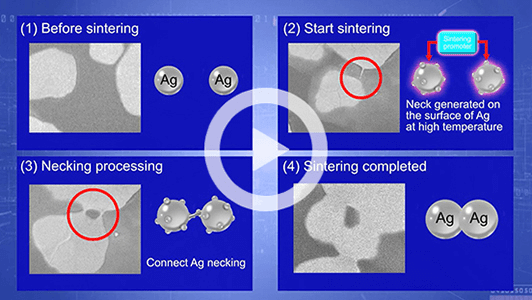
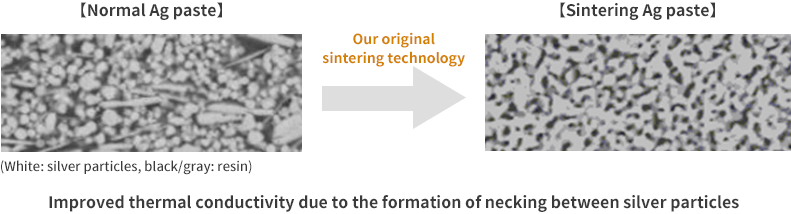
Using our unique
sintering promoter technology, we have achieved high sinterability even with sub-micron silver, which
is more affordable than nano silver, enabling us to create a cost competitive paste with high thermal
conductivity
Furthermore, the hybridization of resin and silver powder enables adhesion to the Si
surface and enhances flexiblity, thereby promoting high reliability
Cross-section image
Production plant
- Ustunomiya Plant
- Sumitomo Bakelite (Suzhou) Co., Ltd.
- Sumitomo Bakelite Singapore Pte. Ltd.
Laboratory
- Information & Telecommunication Materials Research Laboratory
- Information & Telecommunication Materials Research Laboratory (China)
- Information & Telecommunication Materials Research Laboratory (Singapore)