

Policy and Basic Approach
FY 2026 Environmental Policy and Top Priority Measures (Revised on April 1, 2026)
1. Basic Policy Statement
We are committed to contributing to a society that strives for the Sustainable
Development Goals (SDGs) by actively engaging in Responsible Care that prioritize environmental
protection, health, and safety.
Through continuous improvement and evolution of our initiatives, we aim to enhance both social and
corporate value.
- (1) To address climate change, we are committed to reducing greenhouse gas
emissions in line with Science Based Targets (SBT). We actively promote energy efficiency and the
adoption of renewable energy to achieve emission reductions, while continuously exploring
reduction methods by keeping a close eye on emerging technological trends.
Additionally, we will actively work to encourage greenhouse gas reductions throughout the entire supply chain. - (2) To realize a circular economy, we will promote waste reduction and resource circulation. We minimize and optimize resource usage in manufacturing processes while actively advancing the principles of Reduce, Reuse, Recycle, and Renewable for plastic resources, thereby aiming to achieve an environmentally responsible society.
- (3) We recognize biodiversity conservation as a critical issue and strive to minimize the impact of our business activities on ecosystems. Additionally, we aim to contribute to biodiversity conservation through initiatives such as preserving biotopes within our facilities, engaging in dialogue with local communities, and promoting environmental education.
- (4) We ensure strict compliance with legal requirements through a management system that incorporates the latest chemical regulations in each country, and we guarantee the appropriate provision of safety information to stakeholders. Furthermore, we continuously promote the reduction and substitution of hazardous and potentially harmful substances, aiming to transition to safer and more environmentally sustainable materials.
- (5) Recognizing the importance of limited and valuable water resources, we strive to reduce water withdrawal and promote reuse based on comprehensive water risk assessments. Additionally, we work to lower the environmental impact on water ecosystems by preventing water pollution and ensuring strict wastewater management, contributing to regional environmental conservation and the sustainable use of water resources.
- (6) By reducing the environmental impact associated with our business activities, we are committed to preventing air, water, and soil pollution, as well as suppressing the occurrence of noise, vibration, and unpleasant odors. Furthermore, we actively address environmental challenges such as the suppression of micro- and nanoplastic generation and the marine plastic pollution issue, while continuously striving to implement improvements for both present and future environmental concerns.
- (7) We comply with environmental laws, regulations, and other applicable requirements, ensuring that each employee acts with a strong sense of compliance.
2. Scope of Application
This policy is applied to the Group of Sumitomo Bakelite Co., Ltd., including all business sites as well as subsidiaries and affiliates both in Japan and overseas.
3. FY 2026 Top Priority Measures
- Driving efficiency improvements in production processes.
- Reducing Scope 1 emissions through electrification and waste heat utilization.
- Consideration of the application of new technologies such as hydrogen and methanation. (Scope 1 reduction)
- Reducing Scope 2 emissions through the promotion of solar panel adoption.
- Strengthening supplier engagement toward reducing Scope 3 (Category 1).
Systems (Governance)
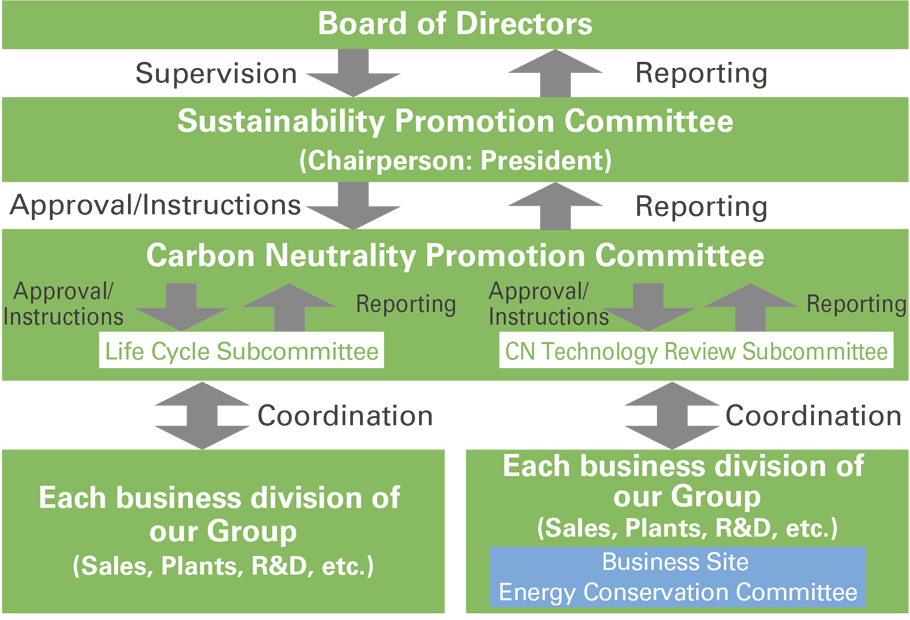
We solve social issues and aim to achieve sustainable growth and value creation under a structure comprising our Sustainability Promotion Committee (which is chaired by the President) and its subcommittees based on our Business Philosophy, which upholds the “Sumitomo Business Philosophy (basic policy)” and sets forth our management principles.
Environmental management involves running responsible care activities for voluntarily implementing and improving environmental and safety measures, in line with our Group’s policies, including the Policy on “Responsible Care Activities” and “Environmental Policy”.
Ensuring that measures are in place toward achieving carbon neutrality is deemed essential these days. To this end, the Carbon Neutrality (CN) Promotion Committee, which also encompasses the “Life Cycle Subcommittee” and the “CN Technology Review Subcommittee” , was established to strengthen and promote CN initiatives in the relevant sectors throughout the Group of Sumitomo Bakelite Co., Ltd.
●Environmental Management Organization Chart
Obtaining Environmental Management System Certification
Our Group has established environmental management system (EMS) based on ISO 14001 and continues to obtain certifications.
For details, see the following link.
Proportion of Manufacturing Sites with ISO 14001 Certification
72%: Based on number of sites
(As of March 31, 2025, proportion of sites that have acquired the certification among all manufacturing sites)
Risk Management
The identification, assessment, and management of risks and opportunities related to environmental issues pertaining to our Group (including reduction of greenhouse gas (GHG), resource circulation, waste reduction, pollution prevention, conservation of water resources, biodiversity conservation, chemical substance management, etc.) are carried out in accordance with the risk management structure and risk management processes described on the following page.
Metrics and Targets
The metrics and targets for the environmental issues pertaining to our Group (reduction of GHG, resource circulation, waste reduction, pollution prevention, conservation of water resources, and chemical substance management) are described on the following pages.
Key Initiatives
Material flows
The figure below shows inputs, including raw materials and energy, and outputs that are products and emissions released into the environment.
Our Group is working to minimize its impact on the environment by reducing waste disposed to the environment and reducing the use of raw materials, energy, and water from the perspective of resource-saving.
We are also promoting CO2 emissions reduction to achieve carbon neutrality.
We are contributing to measures against climate change and particularly global warming through ongoing initiatives to reduce outputs that affect the environment to a minimum.
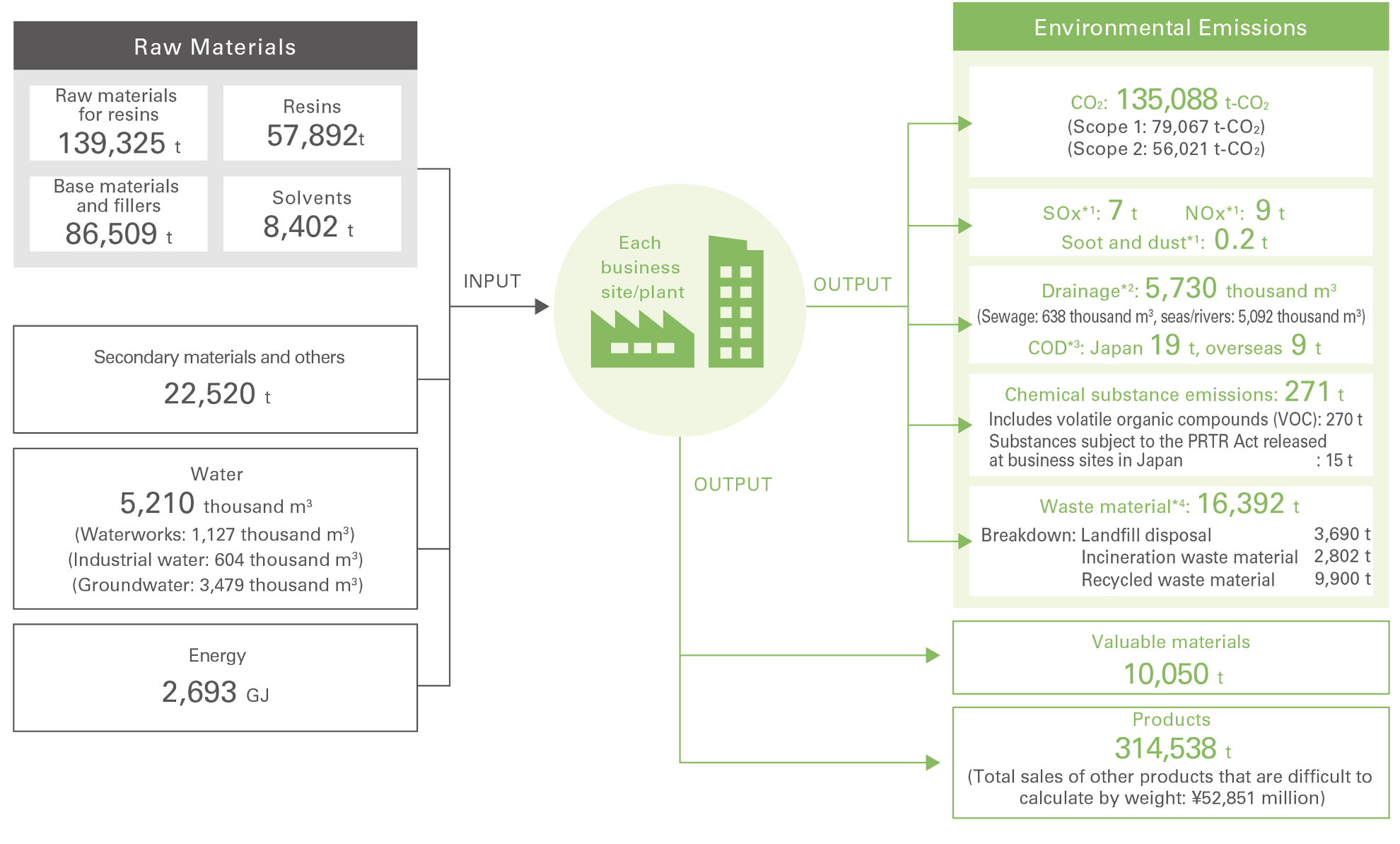
- *1 See the Glossary SOx, NOx, and soot and dust are calculated using the Company’s own formula based on exhaust gas analysis results, fuel usage amounts, and other variables. Includes only domestic data.
- *2 The volume of drainage discharged into sewages is calculated based on the breakdown of total usage, and the volume of drainage discharged into seas/rivers is calculated from waste water flow meters and water intake volumes.
- *3 COD is calculated based on the measured concentration and drainage volume. Data for overseas sites applies to sites where there is a legal obligation to perform measurements, and the types of oxidants (potassium dichromate is mainly used overseas) used for measurement differ from those used in Japan.
- *4 The volume of hazardous waste found in our waste came to 5,203 t, and non-hazardous waste was 11,189 t.
Investments in environmental protection
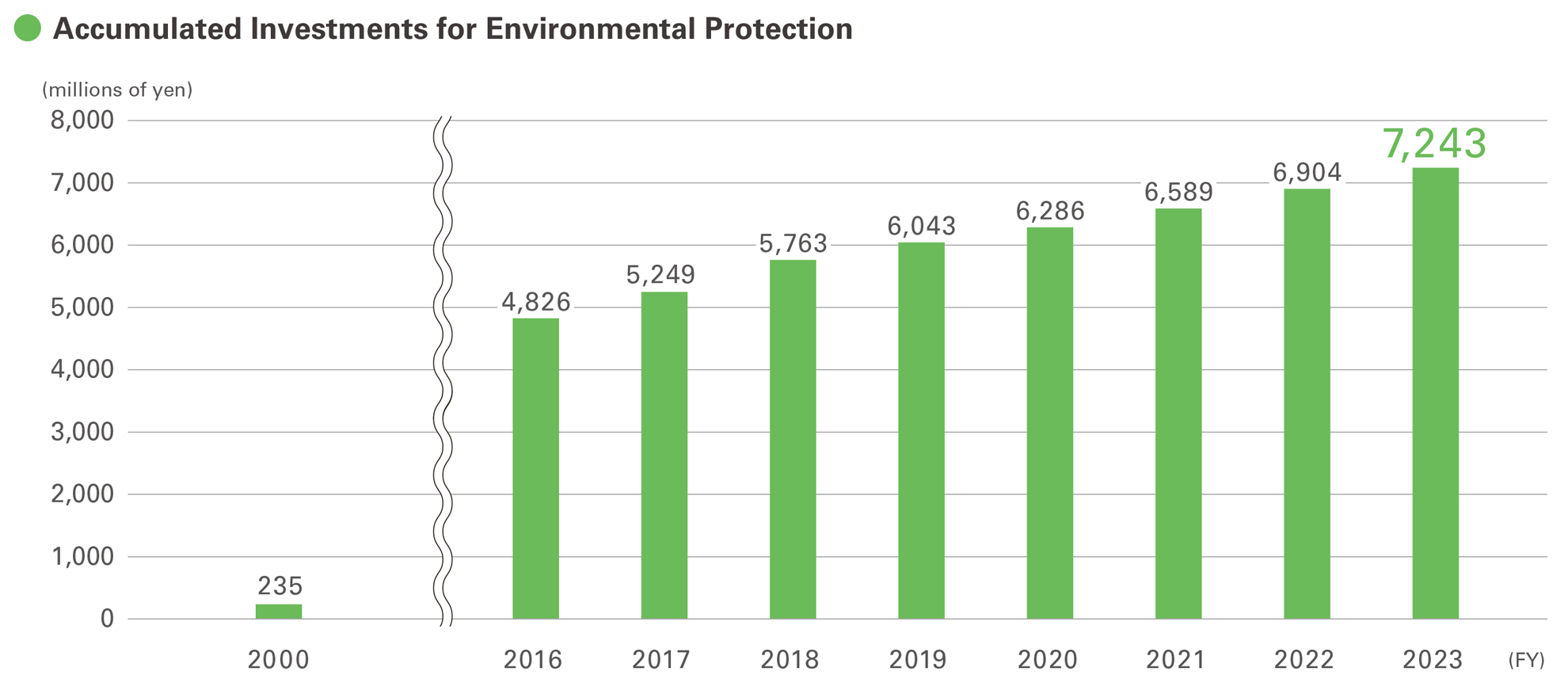
Our Group has compiled data annually on the amounts of investments in environmental protection of all
Group companies in Japan since FY2000. In FY2024, a total of ¥900 million was invested.
Since
FY2020, we have been engaged in a full-fledged effort to adopt solar power generation based on our
commitment to carbon neutrality, and we continued to phase it in at each of our business sites in
FY2024.
We will continue to promote proactive investments in the reduction of CO2 emissions moving
forward.
●Amounts of Investments in Environmental Protection in FY2024
| Category | Investment amounts (million yen) |
|---|---|
| Emissions control | 549 |
| Energy conservation | 342 |
| Waste reduction, recycling, and treatment | 11 |
| Total | 901 |
●Accumulated Investments for Environmental Protection
- 2025/12/17SustainabilitySumitomo Bakelite Co., Ltd. Earns Top “A List” Rating for Climate Change Efforts from CDP
- 2025/11/28SustainabilityIntegrated Report 2025 of Sumitomo Bakelite Co., Ltd. has been issued.
- 2025/05/09SustainabilitySBT Certification granted by the SBTi (Science Based Targets initiative)
- 2025/04/14SustainabilityLaunch of “Project Team to Prepare for Mass Production of Functional Membranes for Hydrogen Production”
- 2025/02/25SustainabilitySumitomo Bakelite Co., Ltd. Receives Gold Medal in EcoVadis Sustainability Assessment
Email us about Sustainability
Inquiry