

Approach to Contributing to SDGs
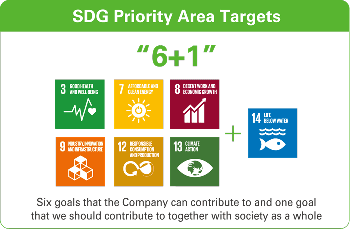
Our Group conducts efforts on SDGs under an understanding that SDG efforts, societal needs, and our Company’s business objectives/Business Philosophy are roughly equally interconnected. We believe that the SDGs together serve as one of the points of reference that will show us the direction in which our Group should move as a plastics manufacturer. The SDGs consists of 17 goals and 169 specific targets for achieving those goals. We have designated “6+1” as our priority area targets in which we can make the most of our business fields and strengths. We have identified the creation of environmental and social values as a material issue for the promotion of sustainability, and are working to contribute to the SDGs as part of this effort. Our Group has been accrediting products, technologies, and activities that contribute to the SDGs as SDG-contributing products, SDG-contributing technologies, and SDG-contributing activities. Certification is granted by the SDGs promotion Committee, subject to approval by the Sustainability Promotion Committee, upon meeting the assessment criteria: the target must be appropriately selected, and a concrete explanation of contributions must be provided, including objective figures based on actual data or publicly disclosed information. As a result, the ratio of SDG-contributing products in sales revenue is increasing every year.
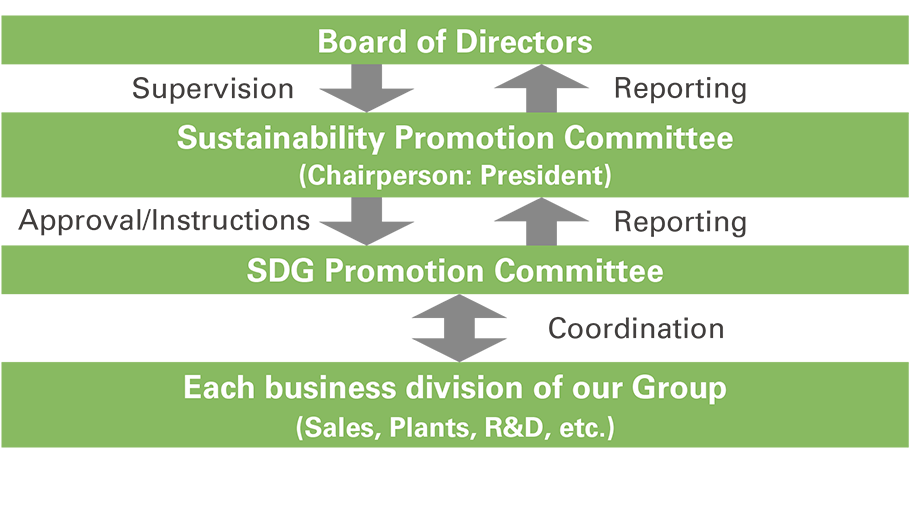
SDGs Promotion System (Governance)
Our Group identified the creation of environmental and social values as a key material issue, and we are
working to contribute to the SDGs through our products, technologies, and activities. To promote these
initiatives, we established the SDGs promotion Committee under the Sustainability Promotion Committee,
and we are investigating contributions to the SDGs from the initial research stages. We also conduct
ongoing discussions concerning our existing products and seek to create new value from research and
other perspectives.
The SDGs promotion Committee regularly reports details of its activities to the Sustainability Promotion
Committee and obtains approval. In addition, the Sustainability Promotion Committee reports its
important decisions to the Board of Directors.
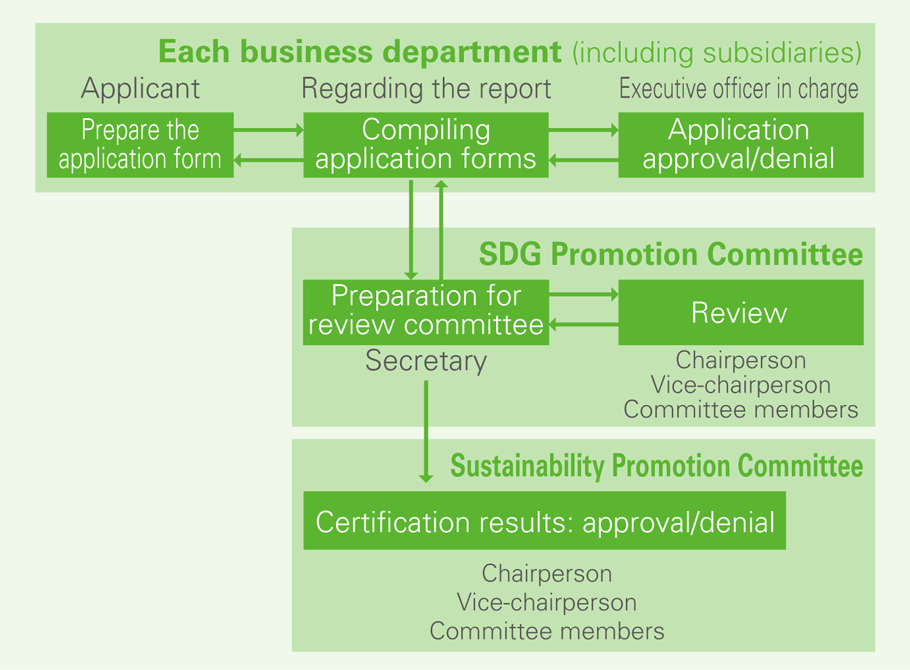
Certification Process, Results, and Targets for SDG-contributing Products, Technologies, and Activities
Since FY2018, our Company Group has been accrediting products, technologies, and activities that contribute to the SDGs as SDG-contributing products, SDG-contributing technologies, and SDG-contributing activities.
Products Eligible for Certification
Certification is intended for products that meet one or more of the following certification requirements ((1) - (8)).
Our Group’s priority SDGs
- (1) Goal 3: The product promotes health and welfare
- (2) Goal 7: The product contributes to improving energy efficiency and implementing new forms of energy (including energy storage)
- (3) Goal 8: The product contributes to achieving job satisfaction and economic growth
- (4) Goal 9: The product contributes to expanding environmentally friendly technologies, and to the foundation of industry and technological innovation
- (5) Goal 12: The product contributes to reducing waste (including food waste) and harmful substances, contributes to reducing environmental impact, and contributes to the realization of recycling and resource saving
- (6) Goal 13: Measures against climate change, and things that help strengthen adaptive capacity to climatic and natural disasters
- (7) Goal 14: The product contributes to the conservation and utilization of marine resources and to the prevention and reduction of marine pollution
- (8) The product contributes to the achievement of one or more of the 17 SDGs other than Goals 3, 7, 8, 9, 12, 13, and 14 listed above.
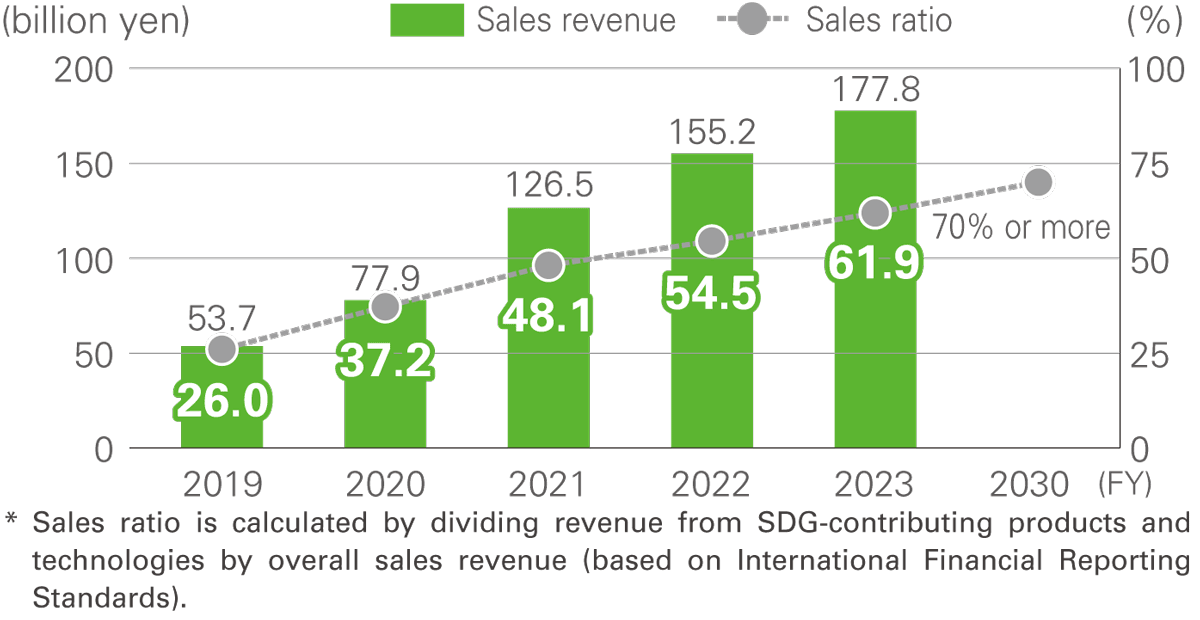
FY2024 Results
Sales revenue ¥202.4 billion Sales ratio66.4%
Target
Sales revenue ratio of at least70% in FY2030
Certification Process
Items reviewed and assessment criteria
- Concrete explanation of contributions: Presented through objective figures based on actual data or publicly disclosed information
- SDGs that the products/technologies/activities contribute to: Selected appropriately
Sales revenue from products and technologies contributing to SDGs (consolidated)
Key Newly-certified SDG-contributing Products and Activities
Liblia™ Zonisamide: Reagent for measuring Zonisamide concentration in blood
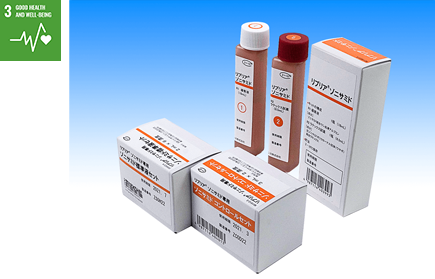
This in-vitro diagnostic reagent is for measuring the blood concentration of Zonisamide, an antiepileptic agent. Until now, methods for measuring Zonisamide required long periods for analysis, specialized equipment, and use of specialized testing centers as in-hospital testing was difficult to conduct. This product, however, allows for simple and rapid 20-minute in-hospital measurement, making use of latex turbidimetric immuno assay and biochemical automatic analyzers commonly installed in many hospitals. Same-day diagnostic results eliminate the need for patients to return to the hospital, allowing medication decisions to be made more quickly for improved seizure prevention.
3.d
Early warning, risk reduction, and mitigation of health risks
Wafer polishing carrier

This product is a glass-epoxy carrier material for wafer polishing. A lightweight, inexpensive, and
easy-to-process insulating material, it generates no minute metal particles during polishing and does not
require a buffer material to protect the edges of the wafer within the holding holes.
Three times more wear resistance than standard products reduces waste.
12.5
Substantially reduces waste generation
Providing environmental education at local elementary schools with visiting guest lessons
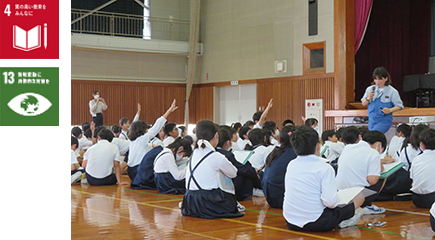
We visit elementary schools near our Shizuoka Plant through our visiting guest lessons initiative to
introduce our activities related to the environment. These lessons help students understand what the
environment and SDGs mean for them, providing an opportunity to think about responding to climate change
and preserving biodiversity.
We are also working in cooperation with Fujieda City and Shizuoka Sangyo University to create on-demand
teaching materials so that municipal elementary schools can conduct these lessons anytime.
4.1
Providing children’s education
13.3
Education on climate change countermeasures
Typical SDG-contributing Products
EBL devices
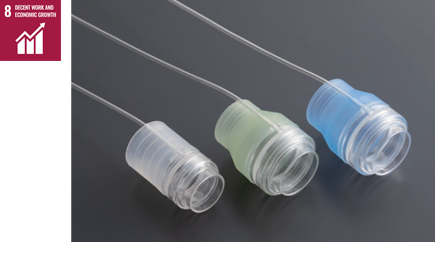
Endoscopic band ligation (EBL) devices are attached to the tip of an endoscope and are used for ligating internal hemorrhoids and bleeding points from colonic diverticula that occur in the lower gastrointestinal tract. By using the EBL technique during hospitalization, the time until discharge and resumption of normal activities can be greatly shortened compared to the earlier clipping method.
8.1
Sustain per capita economic growth
Insulating coating powder for coil ends
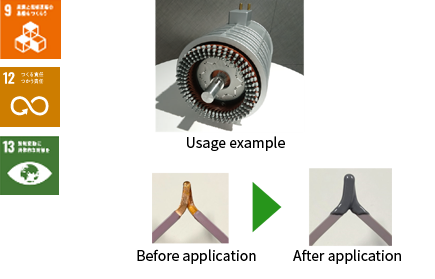
This product is used as an insulating coating for rectangular copper wires used in drive motors. Curing at temperatures lower than commercially-available materials is possible. High Tg and lower curing temperature are achieved through the curing agent design. By lowering the curing temperature, the amount of CO2 generated during curing can be greatly reduced.
9.4
Environmentally sound technologies
12.4
Reduce chemical emissions
13.2
Climate change countermeasures
Making lighter aircraft with Cove Light Panel
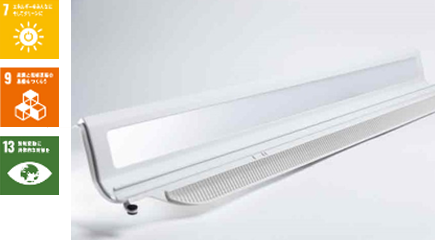
Cove Light Panel, an indirect interior lighting unit, helps reduce the weight of aircraft. This improves their fuel efficiency, contributing to lower CO2 emissions.
7.3
Improve energy efficiency
9.4
Environmentally sound technologies
13.2
Climate change countermeasures
Buffer coat material for power semiconductors

Until now, negative-type buffer coats have been used as insulating protective films for power semiconductors, and an organic solvent developer has been used for this. As such, by improving adhesion with the substrate, which was a problem with positive buffer coats, and solving outgassing generation, it has become possible to use positive buffer coats for power semiconductors. By using this product, it is possible to replace the organic solvent developer with an alkaline aqueous solution, contributing to a reduction in the release of chemical substances.
12.4
Reduce chemical emissions
Polycarbonate sheets with heat ray cutoff capabilities
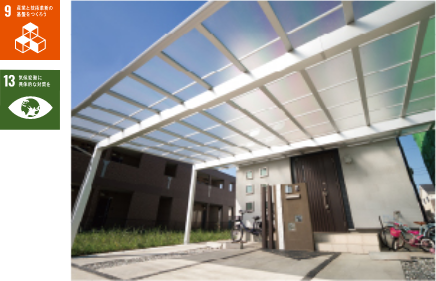
The heat ray reflection grade of Polica Ace™ has a special heat ray reflective filler embedded into the polycarbonate layer to achieve an even higher heat ray cutoff effect than the conventional heat-absorbing grade. (heat ray cutoff rate of 79%).
The heat ray cutoff effect reduces heat at the bottom of the plate, contributing to energy saving and comfort. The panels also come in glossy silver tone, making them a wide range of applications.
9.4
Environmentally sound technologies
13.1
Strengthen adaptive capacity to climatic and natural disasters
13.2
Climate change countermeasures
Liquid epoxy resin for power modules
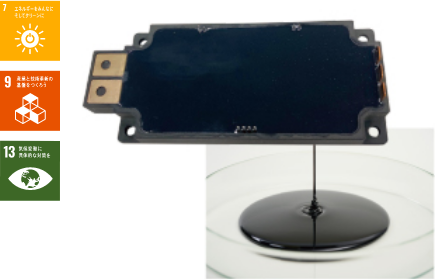
By replacing conventional silicone gels with this product for sealing power modules (case type), the high heat resistance and low linear expansion coefficient of the material reduces stress on joining materials at room temperature to high temperatures, contributing to improving the long-term reliability of power modules.
7.3
Improve energy efficiency
9.4
Environmentally sound technologies
13.2
Climate change countermeasures
Ileus tube series
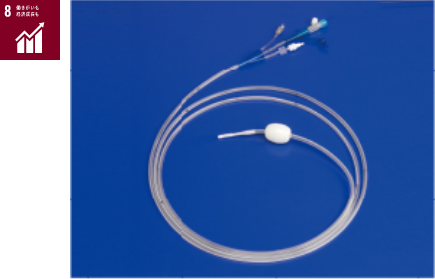
This product is used to decompress and create suction in the intestinal tract via a tube inserted through the nose or anus for ileus (narrowing or obstruction of the intestinal tract). Improvement resulting from its use is seen especially in the initial treatment of early stage ileus.
By significantly reducing the rate of transition from conservative treatment to surgical surgery compared to when not in use, it contributes to the rehabilitation of patients and the improvement of their quality of life.
8.1
Sustain per capita economic growth
Anchor for solar panel with integrated waterproof sheet
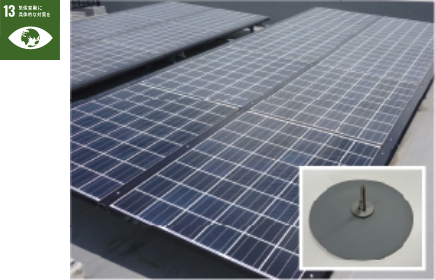
These waterproof anchors can be installed after waterproofing work has been performed, simplifying installation. Integration of anchors with sheets ensures high reliability of waterproofing, with the same guarantee period and long-term fixation strength as the sheet waterproofing, and more than twice the strength of the solar panel power generation guarantee. This contributes to improved reliability of solar panel installation and consequent power generation.
13.1
Strengthen adaptive capacity to climatic and natural disasters