Message from the Executive Vice President
MATERIAL ISSUES
Flying our banner of 12 material issues, we pursue challenges as one to achieve Vision 2030
Redefining our material issues in light of Vision 2030
In 2015, our Group formulated its material issues for the first time, and continued to review them into 2023.
But over nearly the last decade, the business environment has undergone dramatic change, including heightened
pandemic- and geopolitical-related risk. As such, we determined it necessary to redefine our Group’s material
issues from scratch, to allow us to strengthen our initiatives in support of sustainable growth.
In formulating our Medium-term Business Plan 2024–2026, we backcasted from Vision 2030 with a focus on
building a management framework to balance financial and non-financial targets. As part of this process, we
formulated material issues by forecasting future social and economic conditions. The Sustainability Promotion
Department played a core role in characterizing these issues, which were then deliberated comprehensively in
Management Committees and by the Board of Directors. By re-evaluating our Group’s social role from diverse
perspectives, including those of our Outside Directors, we formulated material issues that were better suited
to implementation as well as more convincing. Employees tend to regard non-financial issues in particular as
beyond the scope of their core responsibilities, so to heighten awareness of the fact that, in today’s
corporate environment, such issues can significantly impact enterprise value and are linked to future
financial performance, we engaged in meticulous dialogue and sustained efforts to propagate these priorities
throughout the organization, from the Directors to the level of the front line.
The issue of value creation and its link to the Medium-term Business Plan
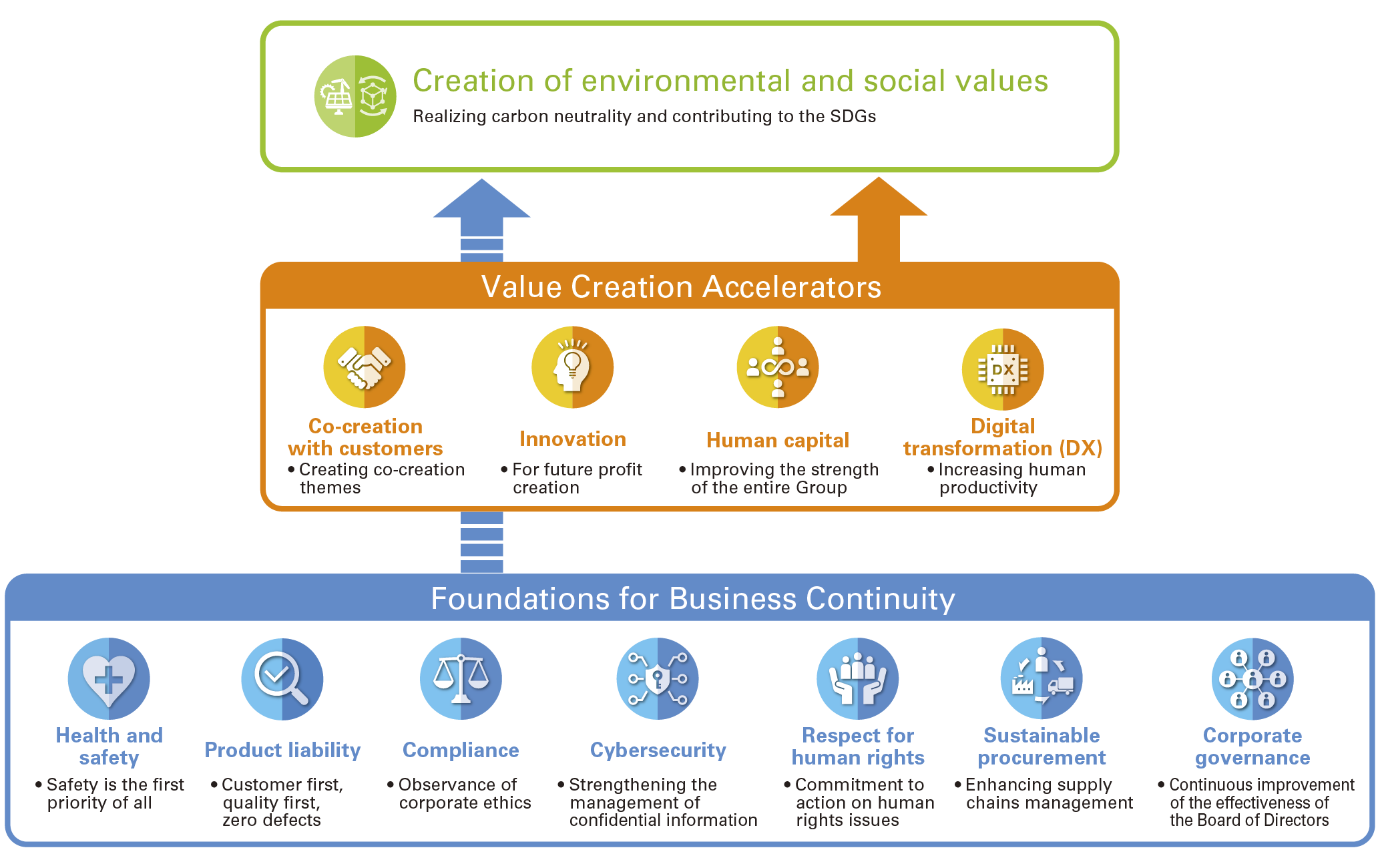
In formulating our 12 material issues, we paid special attention to the creation of environmental and social
values. This priority reflects the principles of the SDGs and the Paris Agreement’s carbon-neutral pathway. It
also directly supports our Group Vision rooted in our purpose, which is to be “a company providing dreams for
the future” through creating value with our customers. To drive creation of environmental and social values,
we have identified four value creation accelerators (co-creation with customers, innovation, human capital,
and digital transformation) and seven foundations for business continuity to underpin these efforts.
Our Group set forth clearly defined profitability-oriented financial targets in the Medium-term Business Plan
launched in 2024. These targets focus not on the volume of sales, but on a fundamental value creation metric,
which is to deliver significant value with minimal resources. Technological innovation is essential to address
environmental challenges such as carbon neutrality, and obtaining the resources for such development also
becomes feasible with profitability-oriented evaluation. In addition, achieving technological innovation
demands both autonomy and organizational strength. To transform our corporate culture, we are steadily
implementing such initiatives as a dedicated department to promote Diversity, Equity, and Inclusion (DE&I),
measures to elevate employee engagement, and psychological safety training for leadership. As a result, a
culture that motivates people to pursue challenges and can accept failures is gradually establishing itself,
from management to the front line.
Behind every effort to deal with material issues, we find people. I am convinced that once a culture of
employees uniting globally to embrace challenges has taken root, our Group will be poised for even greater
achievement.
●12 Material Issues