

Time-of-Day Differences in the Plasma N‑Glycome of Normal and Obese Mice
and the Effects of Dapagliflozin Administered in the Morning or at Night
Yurika Ozawa, Fumi Muramoto, Hana Senda, Maaya Kada, Aya Torii-Goto, Hisatoshi Hanamatsu, Nobuaki Miura, Akihiro Fujita,
Jun-ichi Furukawa, Hiroki Yoshioka, Masae Yoshikawa and Yasuro Shinohara
Journal of Proteome Research, 25 (5), 2558-2568 (2026). | https://doi.org/10.1021/acs.jproteome.6c00081
Copyright: © 2025 by authors.
This article is an open access article distributed under the terms and conditions of the Creative Commons Attribution (CC BY) license
Circadian rhythms, or the body's internal clock, regulate numerous physiological processes, including metabolism, protein expression, and glycosylation. Despite substantial research into its effects on overall health, the impact of circadian rhythms on plasma N-glycome remains poorly understood.
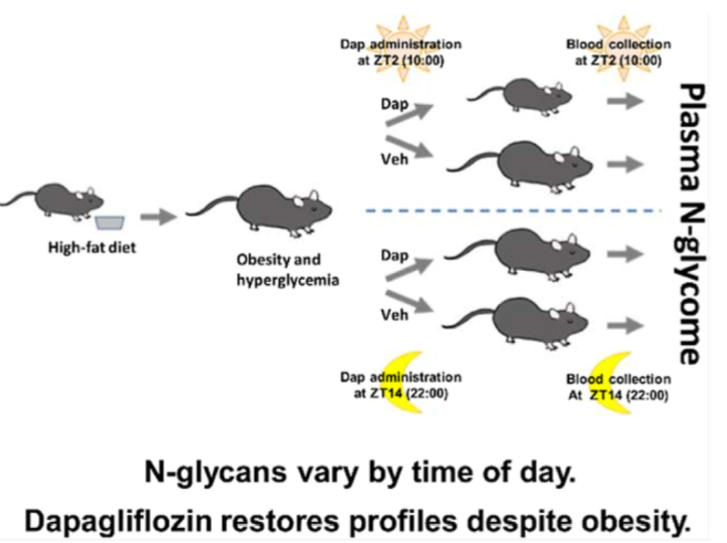
In this paper, the authors examines time-of-day variations in the plasma N-glycome of both normal and obese mice and investigates the effects of dapagliflozin, a sodium-glucose cotransporter 2 (SGLT2) inhibitor, administered either in the morning or at night. Given dapagliflozin's established role in lowering blood glucose and addressing obesity-related symptoms, its influence on plasma glycosylation dynamics adds a new layer of complexity to our understanding of metabolic interventions. Utilizing a quantitative glycomic platform combining BlotGlyco™ kit and MALDI-TOF MS, researchers identified distinct diurnal changes in plasma N-glycome profiles linked to high-fat diet (HFD) feeding. These changes were more pronounced during nighttime evaluations. Nighttime administration of dapagliflozin was observed to normalize several HFD-induced glycan abnormalities, bringing them closer to levels seen in control mice. Importantly, this phenomenon occurred without significant alterations in blood glucose concentration or body weight, suggesting that glycan profiles could serve as sensitive biomarkers of therapeutic action independent of traditional metabolic metrics.
Moreover, results underscore the importance of sampling time when evaluating glycosylation-targeted interventions, as circadian phase profoundly influences biochemical outcomes. This study further implicates circadian rhythm disruption as a contributing factor to obesity and metabolic diseases, highlighting the potential of chronotherapy—timing treatments according to natural biological cycles—to optimize therapeutic efficacy. Future research may leverage glycomic alterations as diagnostic tools or early indicators of disease progression, refining approaches to personalized and time-sensitive metabolic treatments.

Glycan Purification and Labeling Kit
BlotGlyco™
BlotGlyco™ is a sample preparation kit for glycan analysis of biological samples.
Using this kit will purify and label glycans from the crude samples such as glycoprotein, serum, cell, organ, plant tissue and so on. The label is selectable depending on detection methods including HPLC, LC-MS, MALDI-TOF MS and so on.