Background
The technology for generating organoids derived from iPS cells has brought about innovative advancements in regenerative medicine and drug discovery research in recent years. Organoids faithfully replicate the three-dimensional structures and functions of actual tissues and organs, enabling the mimicry of the complex in vivo microenvironment that is difficult to reproduce with traditional two-dimensional cell cultures. As a result, they are attracting attention as novel research models for elucidating disease mechanisms and evaluating drug efficacy and safety.
In this application note, we introduce a technique for the uniform and highly reproducible generation of high-quality human iPS cell-derived kidney organoids using PrimeSurface™. These organoids can be applied to disease modeling, efficacy evaluation, and drug screening, thereby contributing to the efficiency of drug discovery research.
Method
- Induction of iPS Cell Differentiation:
Human iPS cells were induced to differentiate into nephron progenitor cells through stepwise stimulation conditions (including the addition of CHIR99021, Activin A, and FGF-9). - 3D Culture and Organoid Formation:
On Day 8, differentiated cells were seeded onto PrimeSurface™. The special surface treatment promoted cell aggregation and the uniform formation of kidney organoids. - Culture and Evaluation:
After approximately 21 days of culture, the formed organoids were harvested and kidney-specific markers were evaluated by immunofluorescence staining. High-quality, functional three-dimensional tissue formation was confirmed.
Results
By using PrimeSurface™, human iPS cell-derived kidney organoids were formed with uniform size and high reproducibility. Immunostaining analysis also showed proper expression of key cell markers constituting the nephron structure of the kidney, demonstrating the formation of functional three-dimensional tissue morphology.
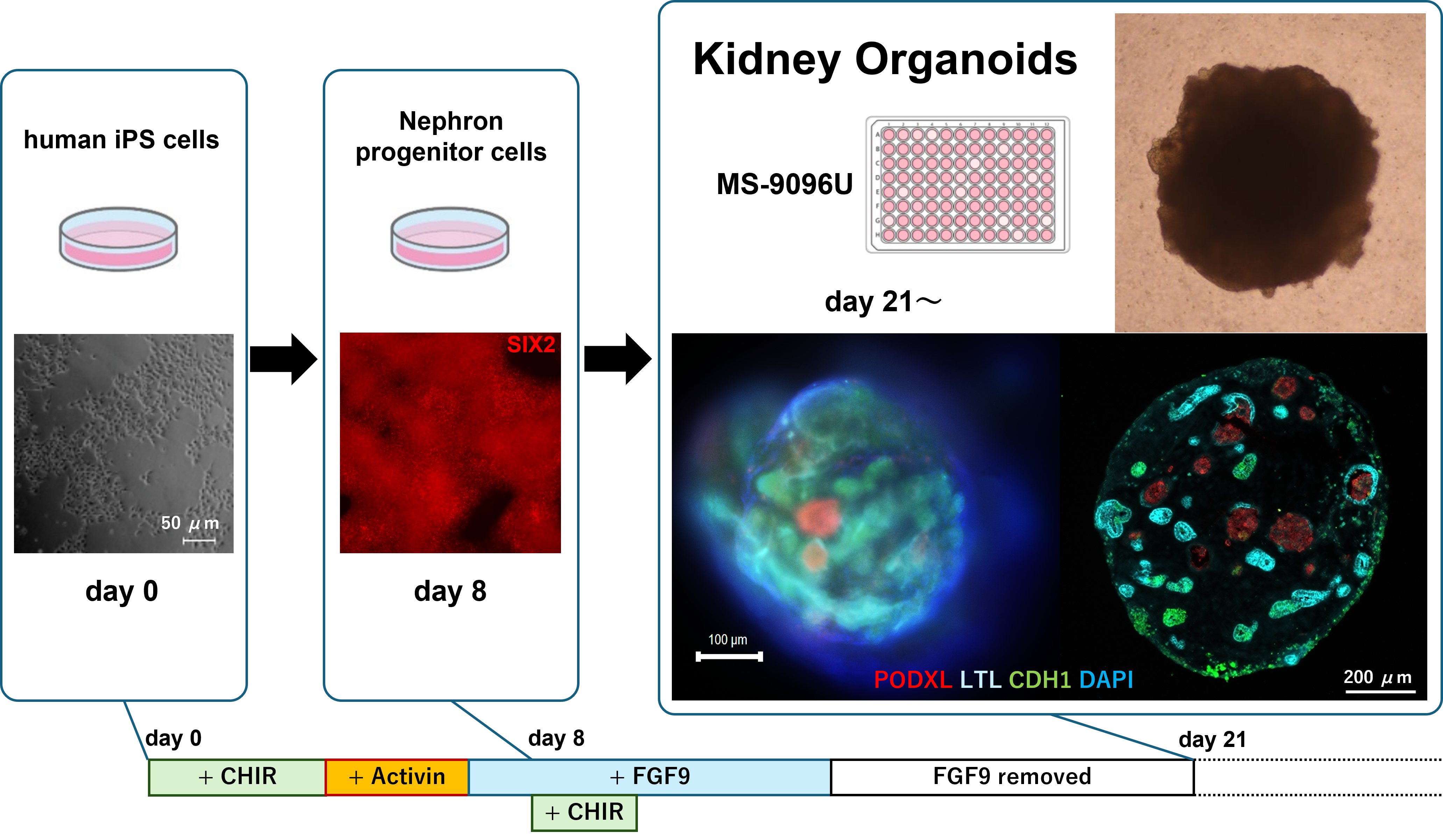
Expressed Markers
(1) PODXL: A membrane protein expressed in podocytes within the glomerulus of the kidney. It plays key roles in podocyte signal transduction, cell adhesion, and interaction with the glomerular basement membrane, crucial for maintaining the kidney's blood filtration function. Used as a marker for podocytes in organoids.
(2) LTL: Specifically binds to the surface of proximal tubule cells by recognizing sugar residues. It serves as an indicator of tubular function and structure identification. In organoids, it is used to identify proximal tubule regions.
(3) CDH1: An important adhesion molecule involved in epithelial cell adhesion, mainly expressed in distal tubules and collecting ducts in the kidney. It helps maintain tissue structure and integrity by mediating cell-cell interactions.
(4) DAPI: A fluorescent dye that specifically binds to DNA, widely used as a counterstain to visualize cell nuclei. It is a fundamental staining method to observe cell presence and nuclear morphology.
[Data Provided by] Koichiro Susa, M.D., Ph.D., Junior Associate Professor, Department of Nephrology, Institute of Science Tokyo
Organoids generated with PrimeSurface™ as drug discovery tools
High Uniformity and Reproducibility:
PrimeSurface™ provides a uniform cell adhesion substrate through its specialized surface treatment, enabling consistent and highly reproducible organoid formation. This reduces variability in drug responses and enhances the reliability of screening assays.
Stable Long-Term Culture Environment:
It offers stability capable of supporting long-term culture, allowing for repeated drug administration and evaluation of chronic effects.
3D Structure Suitable for Functional Evaluation:
By mimicking the nephron structure of the kidney and expressing key cell markers, it enables drug efficacy and toxicity assessments that are closer to actual clinical conditions compared to traditional 2D cultures.
Improved Efficiency and Success Rate in Drug Discovery:
The stable culture system suppresses variability in evaluation experiments, improving the quality of assessment results. This contributes to the efficient disease modeling, drug efficacy evaluation, and drug screening, ultimately enhancing the success rate of drug discovery.
| PrimeSurface™ enables the formation of uniform, highly reproducible, and high-quality organoids, making it a reliable culture system for organoid research. Furthermore, these organoids can be applied to disease modeling, efficacy evaluation, and drug screening, thereby contributing to the innovation and efficiency of drug discovery research. |
|---|