Data provided by: Central Research Institute of Electric Power Industry, Sustainable System Research Laboratory,
Biology and Environmental Chemistry Research Division, Electromagnetic Fields Unit, Senior Researcher Atsushi Saito
For more details, please refer to the paper: Stimulus effects of extremely low-frequency electric field exposure on calcium oscillations in a human cortical
spheroid. Saito A, Shiina T, Sekiba Y Bioelectromagnetics. 2025;46:e22521. © 2024 The Author(s).
This is an open access article under the terms of the Creative Commons Attribution License (Figures are cited from the original paper, with the figure numbers changed)
For accurate evaluation of biological effects of electromagnetic fields at the cellular level, it is important to use biological samples that closely resemble human organs in experimental studies. However, although public health has not evaluated EMF exposure experiments using isolated cultured networks derived from human brain/central nervous system, this is vital to assess the relevance of results from cell culture experiments. In this study, we applied human cortical spheroids (hCS), which are composed of human iPSC-derived neurons and have a three-dimensional neural network structure, to EMF exposure experiments to investigate whether the stimulus effects, which are the basis of international exposure guidelines for EMF, can be evaluated.
hCS produced using PrimeSurface™ can replicate three-dimensional neural network structures similar to those in vivo, enabling the evaluation of neurostimulatory responses to electromagnetic fields in an environment closer to that of living organisms.
This application note introduces the method for producing hCS using PrimeSurface™ and demonstrates its usefulness as a new in vitro evaluation model for research on the neurostimulatory effects of electromagnetic fields.
Production of Human Cortical Spheroids (hCS)
hiPSC-derived neural progenitor cells (ReproNeuro; ReproCell) were used and seeded onto PrimeSurface™ Plate 96U under the following conditions:
Seeding density: 3x10⁴ cells/well
Differentiation medium: ReproNeuro MQ medium (medium changed on days 3, 7, and 14)
Long-term culture medium: Neurobasal Plus medium (Thermo Fisher Scientific) base (from day 21 onwards)
hCS were generated through several months of culture in PrimeSurface™ Plate 96U.
Evaluation of Functional and Stimulus Effects Using hCS
Functional evaluation of hCS using multi-electrode array (MEA) system:
Using the MEA system (MED64) from Alpha MED Scientific Inc., functional changes associated with hCS maturation were evaluated over several months, using temporal changes in extracellular potentials measured from the same hCS as indicators.
Evaluation of neurostimulatory effects of electromagnetic field exposure using Ca imaging:
Changes in neural network activity during extremely low-frequency electric field (ELF-EF) exposure were evaluated by Ca imaging using a fluorescence microscope. For electromagnetic field exposure experiments, samples of uniform size were used, with hCS diameters ranging from 0.9-1.1mm. Additionally, Fluo-8 AM (AAT BioQuest), a fluorescent indicator, was used for Ca imaging.
Using PrimeSurface™ enables efficient production of
spheroids with uniform size
Results
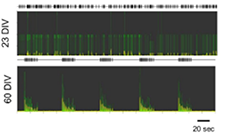
- As a result of evaluating the extracellular potentials around the hCS over time, it was found that stable burst-like neural network activity could be detected after approximately 2 months of culture (Figure 1).
- Using Ca imaging, neural network activity patterns consistent with extracellular potentials were optically detected (Figure 2).
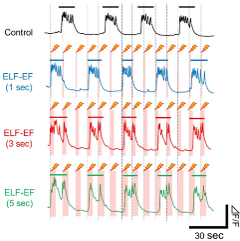
- During ELF-EF exposure, the occurrence pattern of neural network activity changed clearly compared to non-exposure (Control) conditions (Figure 3).
These results indicate that neurostimulatory effects induced by ELF-EF exposure can be detected even when using hCS.

| 3D hCS generated using PrimeSurface™ are useful for evaluating the stimulus effects of electromagnetic fields in an environment that is closely resembles to in vivo state |
|---|